
Artists Letters
Rowena’s Letters
A Story from the Bush – Now Available to Collect
If you are searching for original Australian landscape art that captures the spirit of the outback, I am pleased to share that my newest work, A Story from the Bush, is now available for sale.
Collecting Australian Landscape Artists Paintings: What to Look For
Collecting Australian landscape artists' paintings is more…
Outback Art Gallery Featuring Paintings Shaped by Lived Experience
An outback art gallery is more than a place to display paintings.
Childhood Hunting
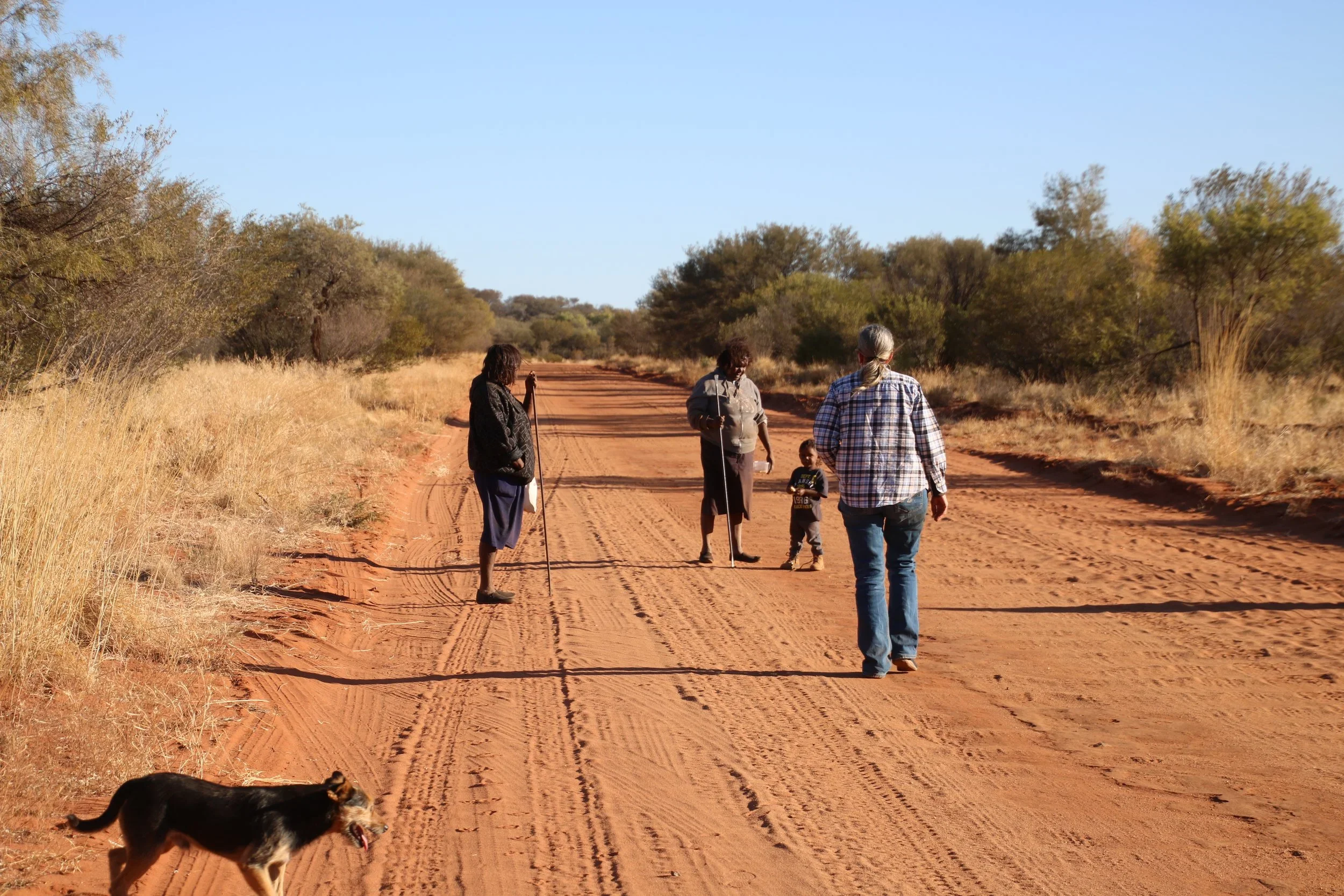
Hi everyone, I promised more stories of my childhood, I wrote this story when my children where small so that one day they would understand my strong connection to the bush and my childhood that shaped the person I am.
Alcoota Childhood
The other day, while cleaning my office, I found some stories I wrote years ago about my childhood growing up on Alcoota Station. I thought by sharing these, you’ll better understand my love and connection to the land—and how deeply it influences my art. This is part one.
Go with the Flow
I haven’t done much painting over the school holidays — I decided to make the most of having Harley (grandson) home. Such a lovely young man, sixteen now and on his L-plates. He got some real dirt-road driving experience on our trip to the Gregory.
Gregory River
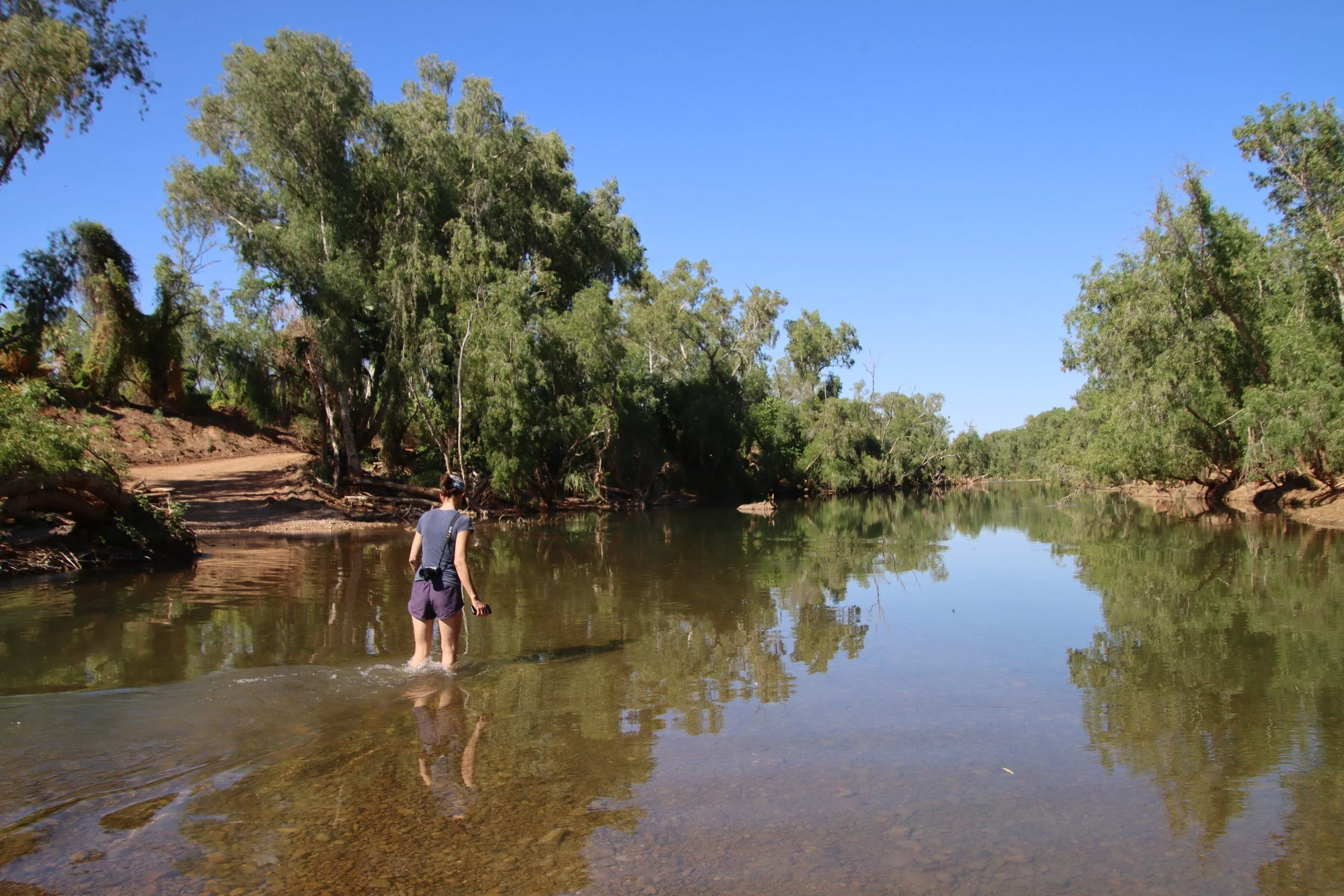
I’ve just spent four wonderful days camped on the amazing Gregory River with my children and grandchildren. The Gregory is a spring-fed river, flowing from limestone aquifers on the NT border, winding its way north through rocky gorges and dry plains — a true lifeblood to the cattle stations before it empties into the Gulf of Carpentaria.
Where My Landscape Inspiration Comes From
I’m often asked where I get the inspiration for my landscape paintings.
The Power of Black and White
I began studying at the Academy of Realist Art in Toronto to refine my portrait work—and it’s done….

Through the Curry Hills
My latest painting “Through the Curry Hills” for our Cloncurry Exhibition Opening Night 30th of July….

16/9/2025
Hi, How are you going today.
The other day, while cleaning my office, I found some stories I wrote years ago about my childhood growing up on Alcoota Station. I thought by sharing these, you’ll better understand my love and connection to the land—and how deeply it influences my art. This is part one.
Alcoota is a small cattle station on the Plenty Highway, northeast of Alice Springs in the Northern Territory. My dad managed it for a gentleman in Adelaide. Compared to the larger stations he had managed—Barkly Downs, Lake Nash, and the remote Elsley Station—Alcoota was, as Dad always said, “a holiday.”
For us three youngest of six kids, it was a paradise. Our older siblings were away at boarding school in Charters Towers and only came home for Christmas. We “little girls” were taught through School of the Air and correspondence lessons by an array of governesses—some good, some not so good. (For my American readers: governesses were young women who basically home-schooled children on remote stations.)
Alcoota was run by Dad with occasional help from a mechanic and his family, but mostly it was just us and the community of local Aboriginal people, who worked as stockmen, gardeners, and cleaners. My mum had to be a jack-of-all-trades: cook, gardener, storeman, bookkeeper, secretary for race clubs, sometimes teacher, and often arbitrator for a camp of more than a hundred Aboriginals. She even ran a clinic—handing out cough mixture, sewing up split scalps after fights, and delivering babies. She wasn’t a trained nurse, just a woman who had to cope with all emergencies in the remote outback. Dad was always quick to volunteer her services: “Yes, Ed can do that standing on her head!”—and suddenly Mum had another unpaid job.
Of course, she had three “offsiders.” I remember cleaning halls, scrubbing toilets, and making decorations for the Harts Range Races at a very young age. Looking back, I can see where I inherited my coping strategies and my lifelong habit of volunteering.
As children, though, we had no real sense of our parents’ workload. After breakfast, we’d disappear—on horseback, exploring the creek, or hunting with the Aboriginal ladies. School was a torturous couple of hours shut inside a room. I’d sit gazing out the window, watching the horses coming in to water, working out how far away they’d be when it was time to catch them after school.
Often we’d pack a lunch and just ride all day—playing cowboys and Indians, practicing our mustering skills (unbeknownst to Dad, or so we thought)—and come home at dark. It was a carefree existence: no peer pressure, no drama, just freedom.
And it’s from this childhood—this life on the land—that my art draws its strength and meaning.
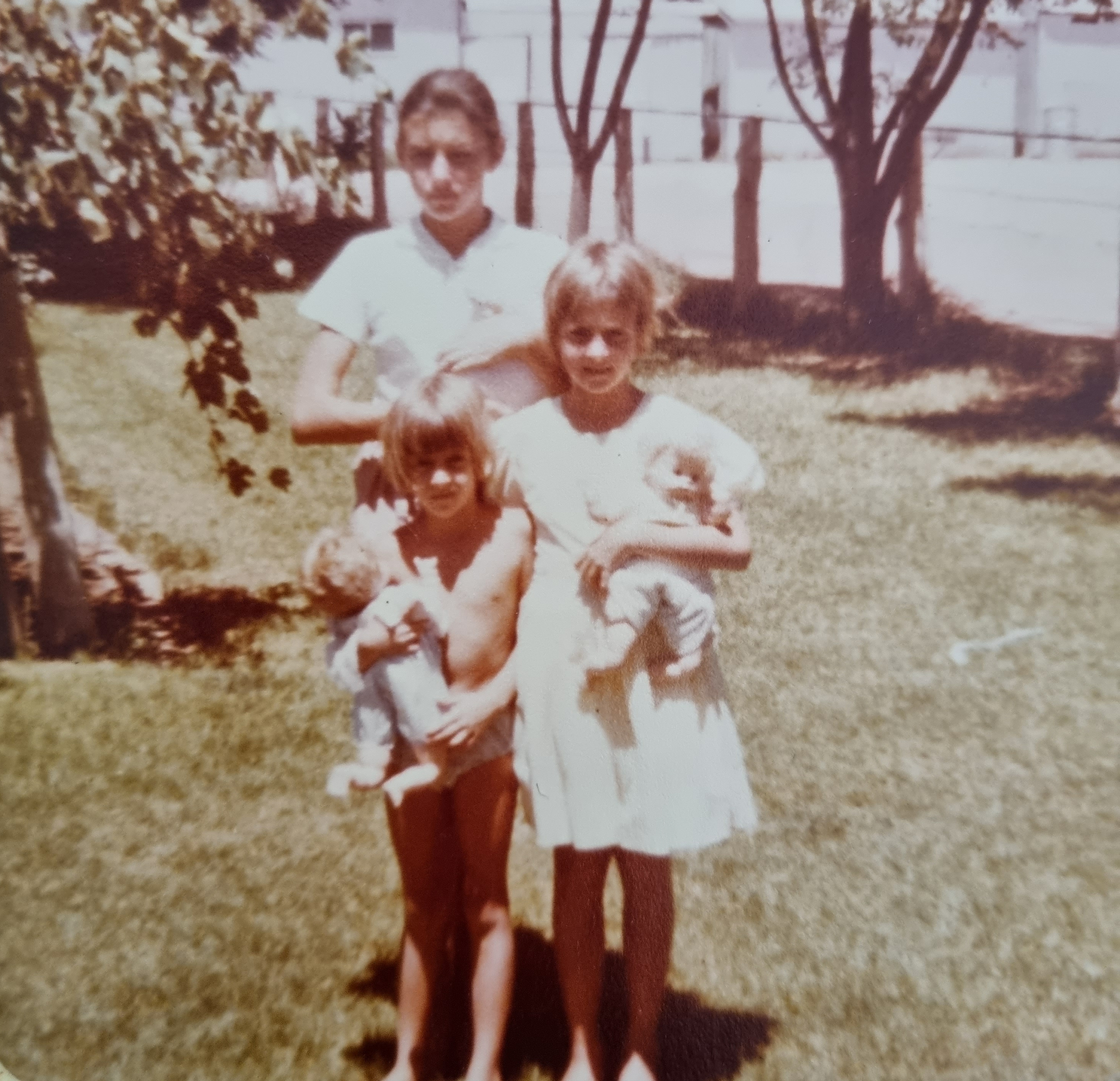
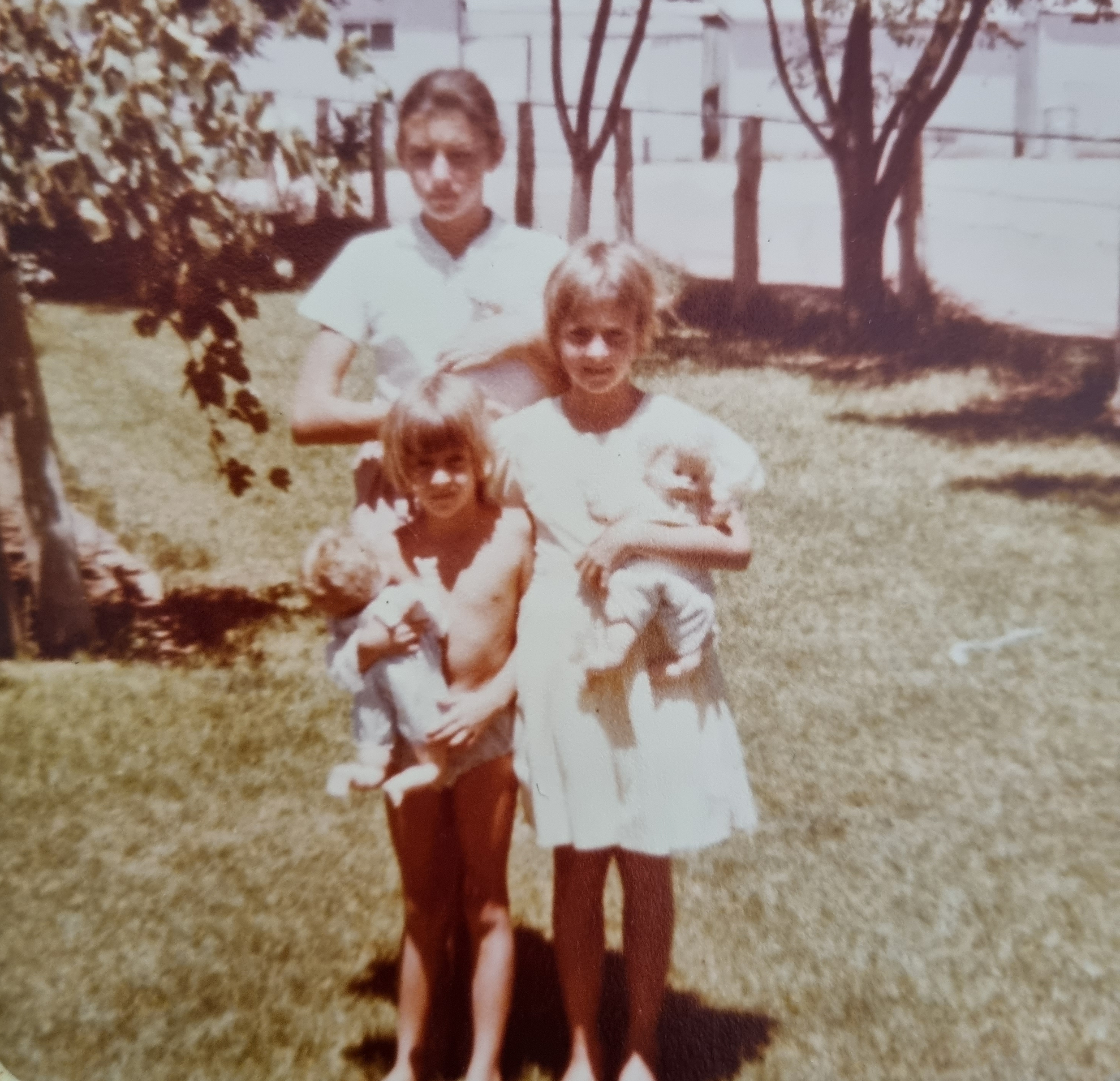
“The three little girls” Yes I was one of those children that only wore underpants, even riding our ponys, No safety gear in thoes days!
“I have many more stories from those days on Alcoota, and if you’d like to hear more, let me know—I’d love to share them with you in future newsletters.”
Cheers Rowena
23/9/2025
I promised more stories of my childhood, I wrote this story when my children where small so that one day they would understand my strong connection to the bush and my childhood that shaped the person I am.
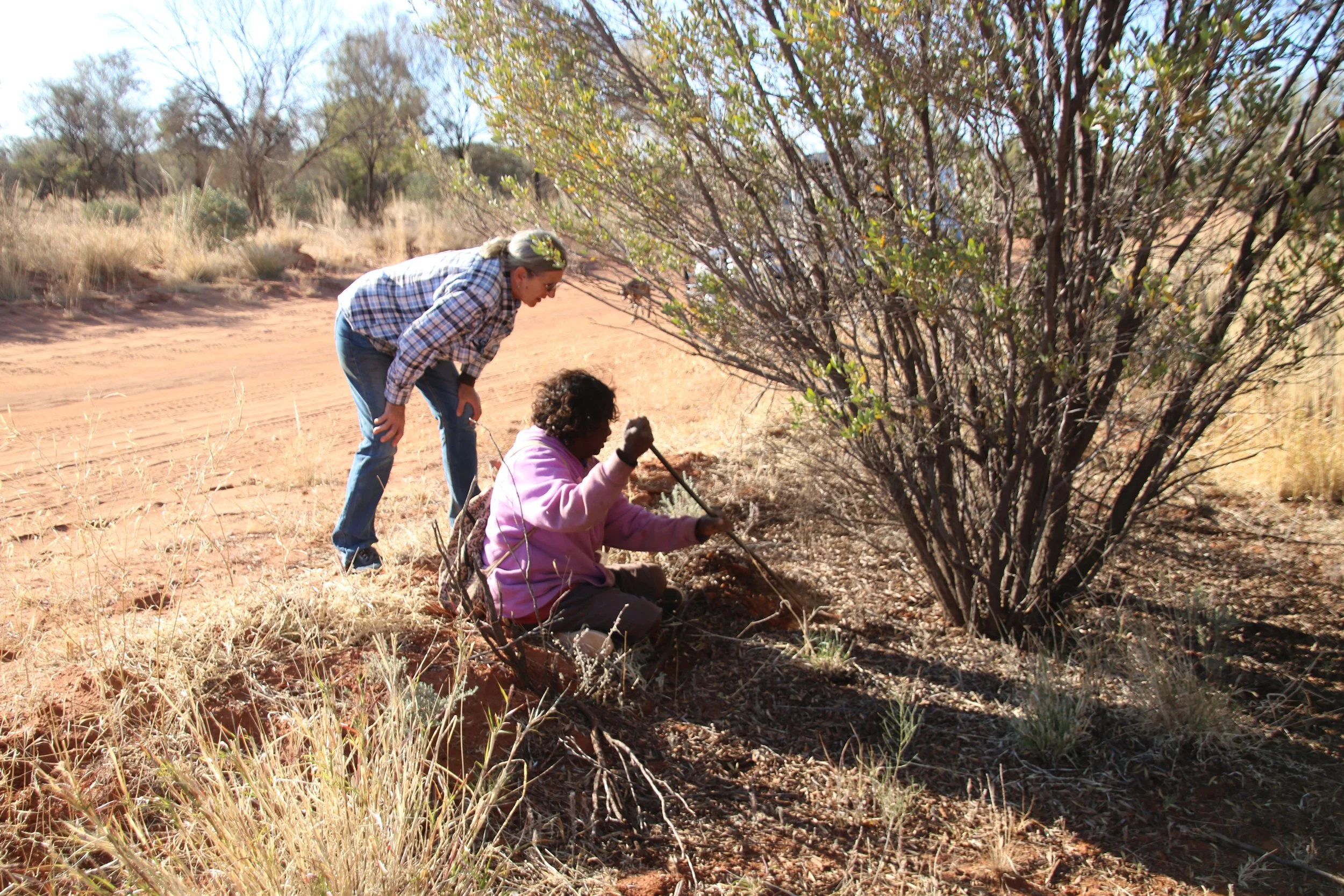
I was about seven the day Ada and Maggie took us hunting. My sisters and I trailed along, barefoot and excited, while the women carried a coolamon, a billy can, a sack, and a digging stick. The coolamon, a shallow long wooden bowl made from a hollowed log, would hold berries or grubs. Sometimes, if it was big enough, it could cradle a newborn baby, balanced easily against the hip. The billy can was just an old tin with a wire handle, but it carried anything and could be used to boil water for tea.
We set off down the creek. It was wide and sandy, only flowing with water in the wet season. After seven years of drought, I had never seen it run full. In the silt and sand grew ulgas — little onions, nutty and sweet. We squatted in the dust, digging them up with our sticks, hands dirty, mouths already watering.
Ada found the tracks of a porcupine — an echidna — and we followed them to a burrow under a big old gum. She began to dig, but just then one of the dogs spotted a goanna. Shouts and laughter erupted as we all tore after it — in and out of the riverbed, scrambling up banks, sliding down again. At last the dogs caught it by the tail. Maggie grabbed it quick as a flash, stuffed it into the sack, and slung it over her shoulder. The hunt was looking good.
When the chase was over, we rested under the cool shade of a white river gum while Ada worked to drag the echidna from its hollow. The leaves of the gum were dotted with little white sticky blobs — sugarleaf, the sweet homes of tiny sap sucking insects. We peeled it off the leaves, filling the billy can with the sticky treat, laughing and talking while we waited.
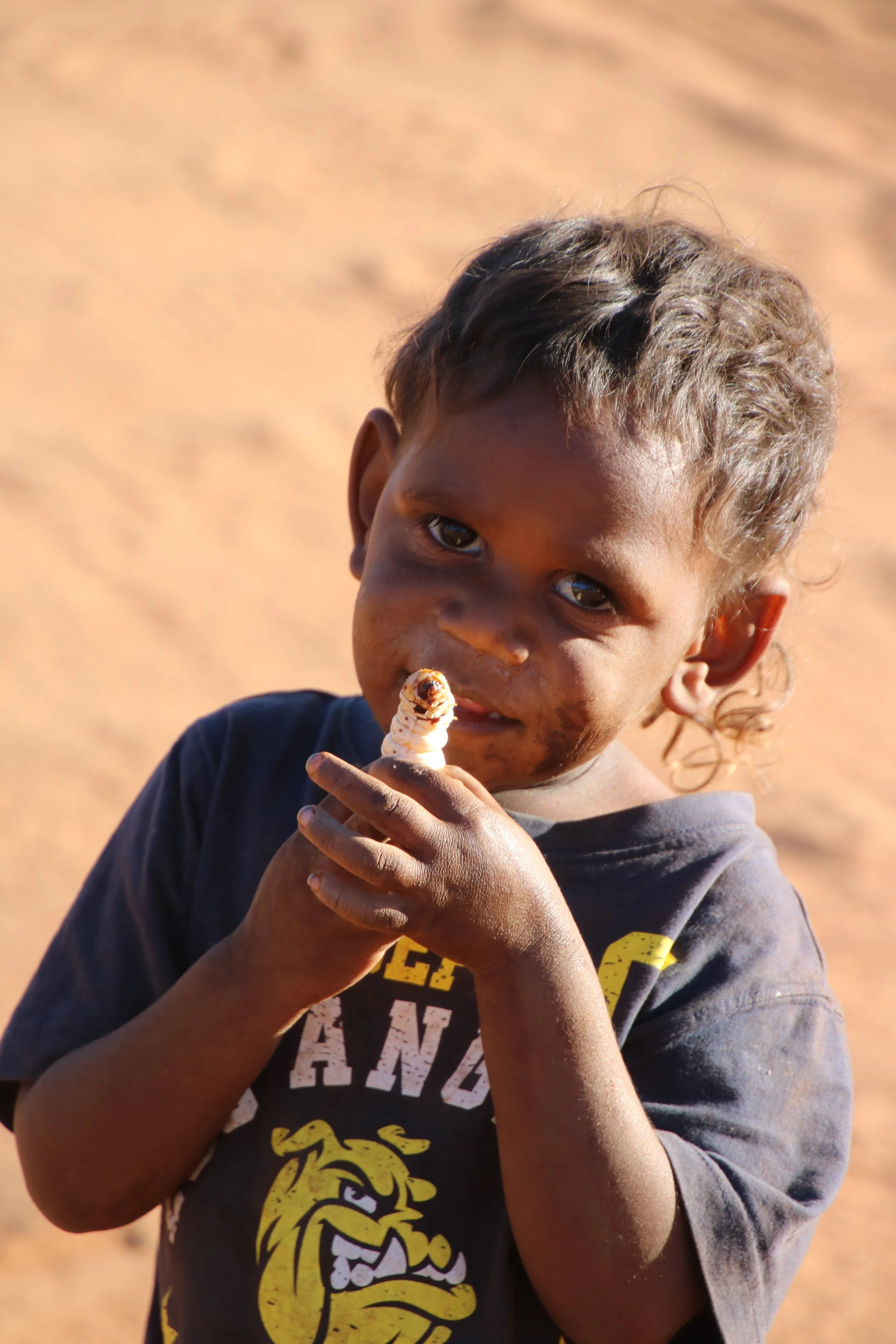
I wandered along the creek bank and found a wild passionfruit vine heavy with bright orange fruit — and ants. Millions of them. It took quick fingers to pick the fruit and toss it into the coolamon before the ants swarmed up my arms. By the time I came back, the women had found witchetty grubs in a gum branch. They split the wood and, with a hooked bit of wire, teased the fat white grubs out of their holes. Into the coolamon they went. Eaten raw they were squirmy, but roasted on the coals they tasted buttery and nutty.
By now we had quite a haul — a goanna and an echidna in the sack, a coolamon full of grubs and ulgas, and a billy can of sugarleaf, and passionfruit. On the way back home we passed conkerberry bushes heavy with little black berries. We picked them by the handful, probably eating more then went into the Billy.
Back at camp old Tom already had a fire going, with lots of glowing red coals. Ada dug a shallow pit, laid the goanna and echidna on the embers, and shoveled more hot coals on top. While they cooked, we tossed the witchetty grubs onto the fire. They sizzled and spat until the skins crisped and the insides turned golden. With roasted ulgas on the side, they were delicious.
When the meat was ready, Maggie pulled the goanna and echidna from the fire, scraping away the ash. We feasted with our fingers, tearing into the smoky flesh, then washed it down with mugs of black billy tea. Afterward, there were passionfruit, sugarleaf, and berries for dessert.
What a feast it was.
Hope you enjoy these stories I am sharing. With every gum tree I paint, I want you to feel the bond my sisters and I grew up with — a deep connection to the land that shaped me, and now flows through my art to you.
Cheers Rowena
Good Morning Art Lovers
I love working towards an exhibition — dreaming up a theme, choosing a name, then planning what paintings to create, their sizes, shapes, and how they’ll fill the space. I start with works in my traditional style, the ones people expect from me. But as the collection nears completion, I like to step outside my box a bit and push my creativity.
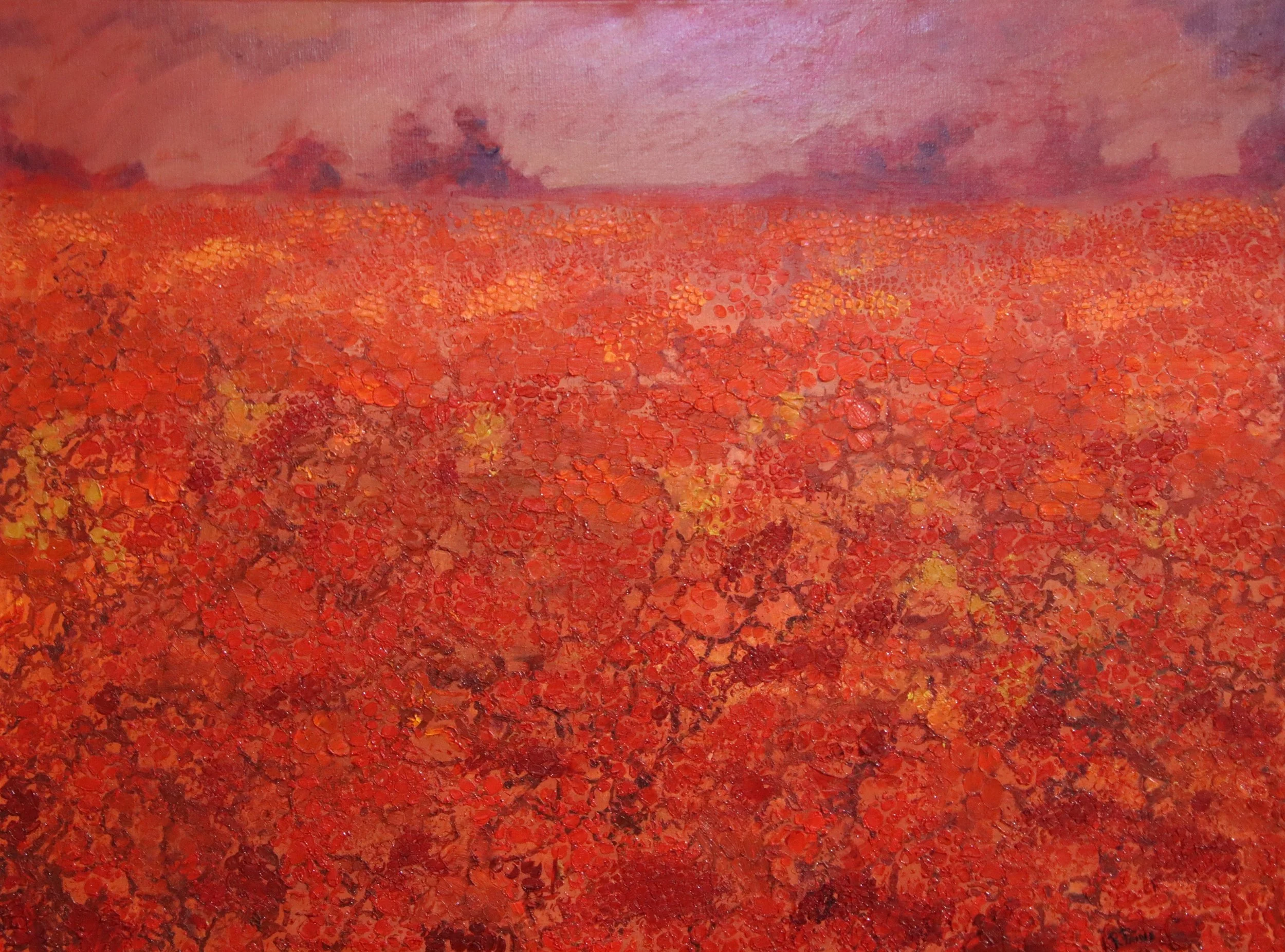
Red Earth is one of those pieces — a tactile work built from layers of paint to mimic the skin of the land, cracked and weathered under a relentless sun. It’s a deceptively quiet landscape: dry, dusty, and scarred, yet brimming with hidden life. Its worn face is a reminder of our own fleeting time here.
I feel privileged to roam this ancient country, to stand in its vastness and bring a piece of it into your home.
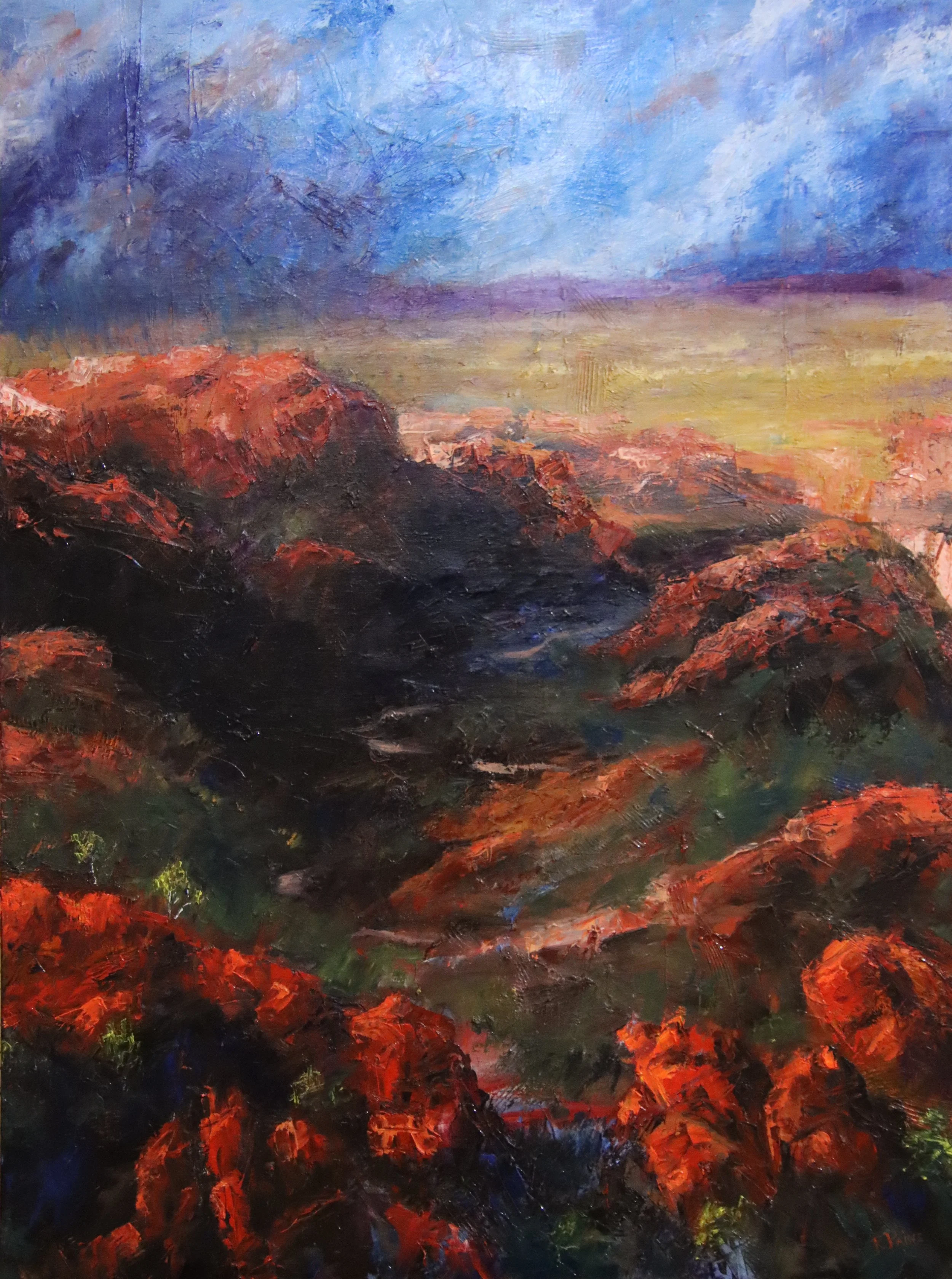
I should have been an eagle as I love the view from the top of a hill — in “Eagle’s View” — I see the land’s form unfurl: red escarpments, secret valleys, rivers spilling onto wide plains. A passing storm breathes life back into the dry earth. We are just a speck in its endless cycle. Created with impasto oil “Eagles View” ia a tribute to Dorothea Mackellar’s My Country.
Sweeping plains, ruggered ranges and flooding rains.
I love this sunburnt country, I’m driven to capture not just the fine detail of the outback, but its soul.
I’m excited to share that in 2026, Claire and I will hold a joint exhibition — I look forward to taking you on that journey in future newsletters.
Cheers,
Rowena
Good Morning
Well, one exhibition down and now it’s time to start planning for the next. Claire and I have been invited to exhibit at the Tambo Regional Gallery in September next year, 2026. Exciting — but it raises the big question: what do I paint?
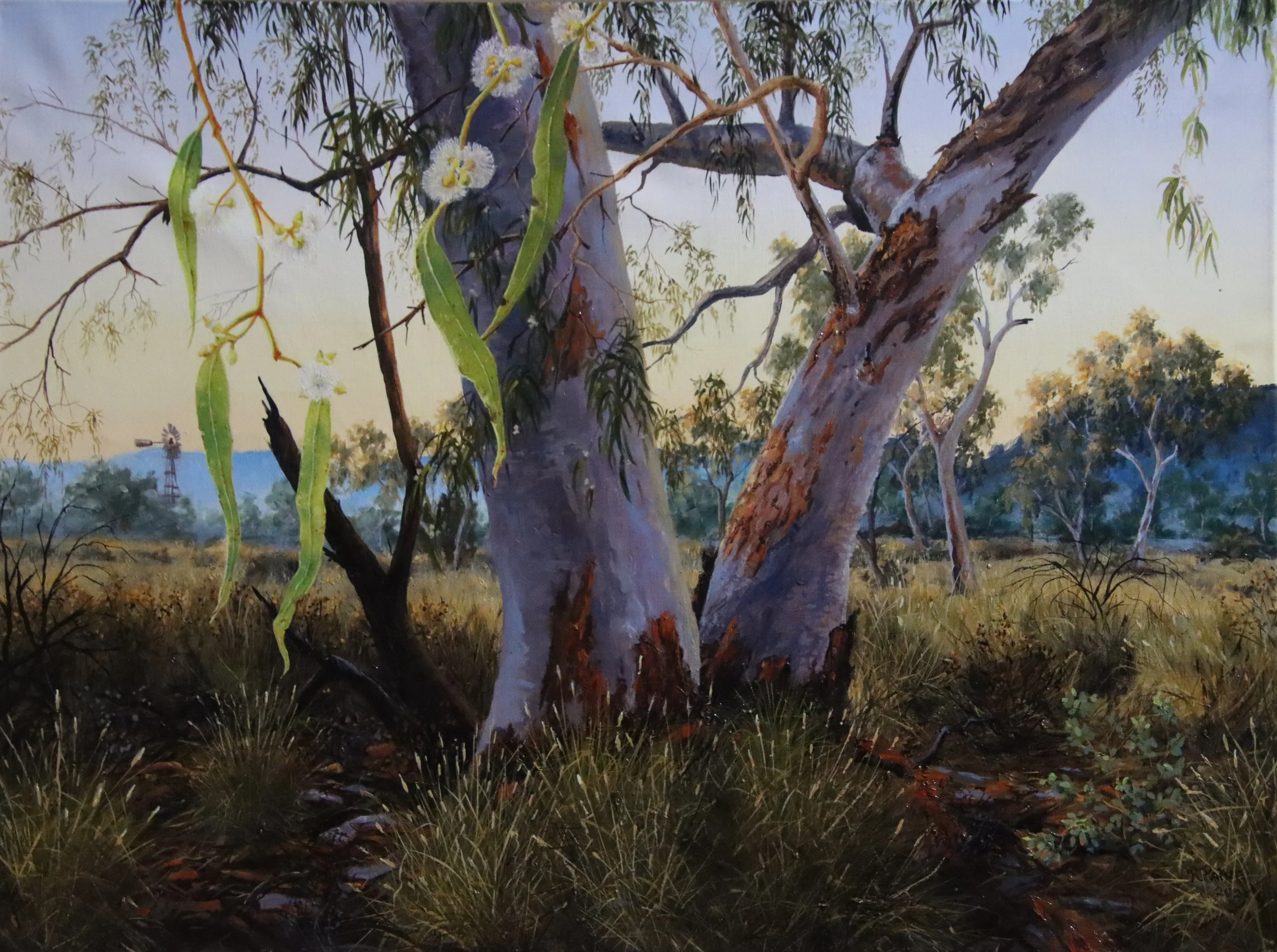
A few years ago, after overhearing some remarks at an exhibition, I wrote a poem called “Just Another Gum Tree.” It was my way of poking fun at the idea that gum trees are “just pretty pictures” and not “real art.” To me, they are characters — shaped by age, weather, drought, fire, and life itself. Every scar, twist, and hollow tells a story.
Just Another Gum Tree
I hear your comment as you pass me by,
In your fancy shoes and with your artistic eye.
“Just another gum tree,” you say with a smirk,
As if I don’t deserve space beside the real work.
But stop a minute. Take a look.
See what the artist has really put.
My proud limbs once stood straight and tall,
Now bent with age — some broken, some fall.
My girth has thickened with passing years,
My lumps and hollows, they hold my tears.
I’ve seen droughts, floods, and fire’s red flame,
And still I’m standing, scarred but the same.
Parrots nest high in my ragged crown,
A big red roo rests when the sun beats down.
I’ve watched first people quietly pad by,
Now I listen to road trains and planes in the sky.
This portrait’s not pretty and may have no fame.
It’s about life’s struggle, its history, endurance and pain.
So next time you see me hanging on a gallery wall,
Remember: I’m more than “just another gum tree,” after all.
The more I think about it, the more I realise: I’ve found my theme. I want to celebrate the gum tree. Not small studies, but BIG canvases that really fill a room.
What do you think? Do you want to see more gum trees? Because I have so many I want to paint — and I’m ready to make them large.
Have a great week.
Cheers Rowena
Newsletters
Our exhibition is finally hung!
It’s wonderful to see each artist’s interpretation of "Colours of the Outback" come to life — vast landscapes in oils and acrylics, delicate watercolours, and a huge metal bull’s head dominating the gallery. All the ladies have worked hard to bring this uniquely outback Australian exhibition together, and I’m proud to be part of it.
To be honest, I’m exhausted. Twelve large paintings in six months, on top of my already busy life, has been quite an ask — but I’ve always worked better under pressure. I’m truly happy with the work I’ve produced and confident they’ll bring joy in their new homes.
As an artist, you work so closely with each piece that a bit of your heart and soul ends up embedded in the layers. Paintings are a lot like raising kids — you give birth to an idea, then struggle to bring it to life. Some are easy, others give you a hard time (a bit like teenagers!), but eventually they grow into something beautiful and worthwhile — something that brings joy to others.
Selling a painting is often bittersweet. You’re putting it out there to be judged, critiqued, and sold. Standing by your artistic process, some are hard to see go but that’s part of the process.
I’d love to see you on Wednesday night at the opening.
Cheers,
Rowena
The Power of Black and White Newsletter 14/4/2025
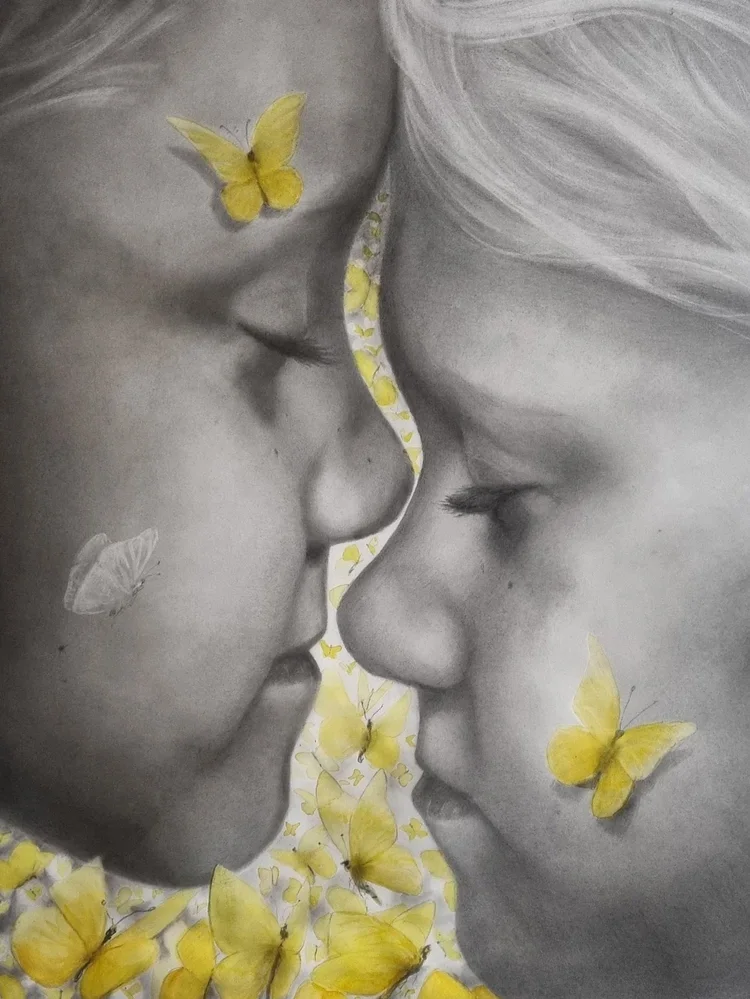
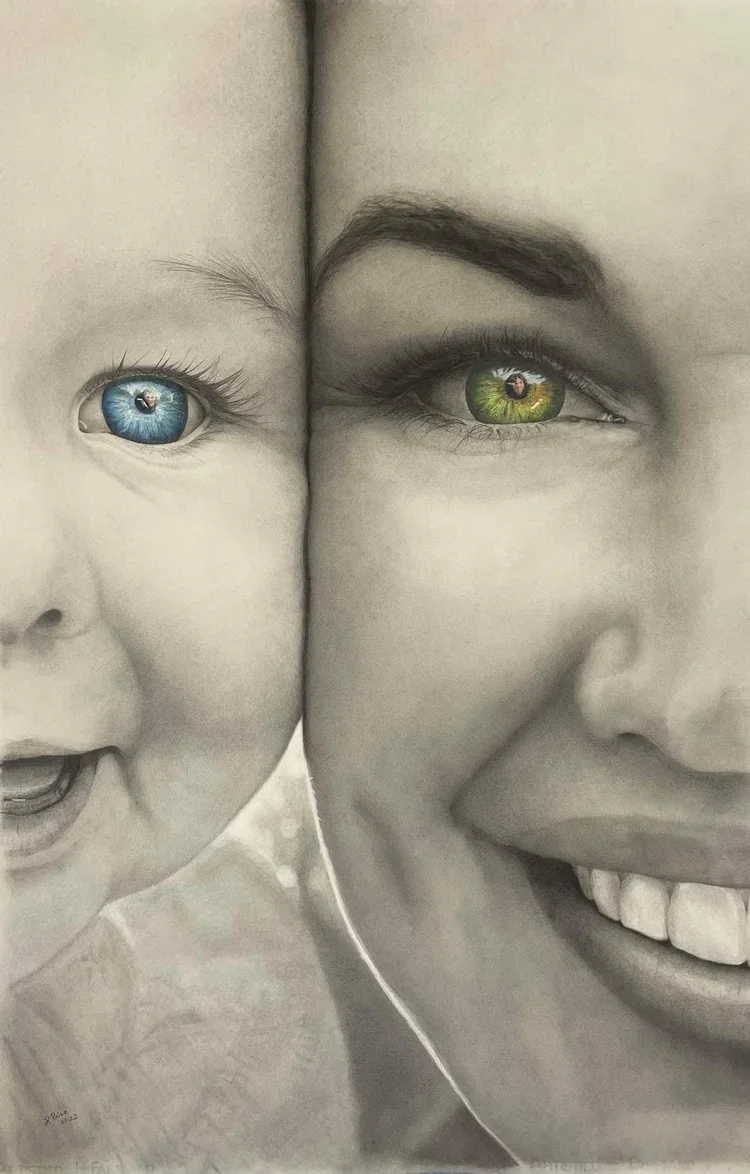
I began studying at the Academy of Realist Art in Toronto to refine my portrait work—and it’s done more than that. It’s reignited my passion for traditional, realistic drawing.
As a kid, I loved working in pencil. But once you become a painter, drawing often becomes the underlayer—something to build on, not something to finish. This course reminded me just how powerful graphite and charcoal can be on their own. No colour, no distraction—just tone, form, and raw emotion.
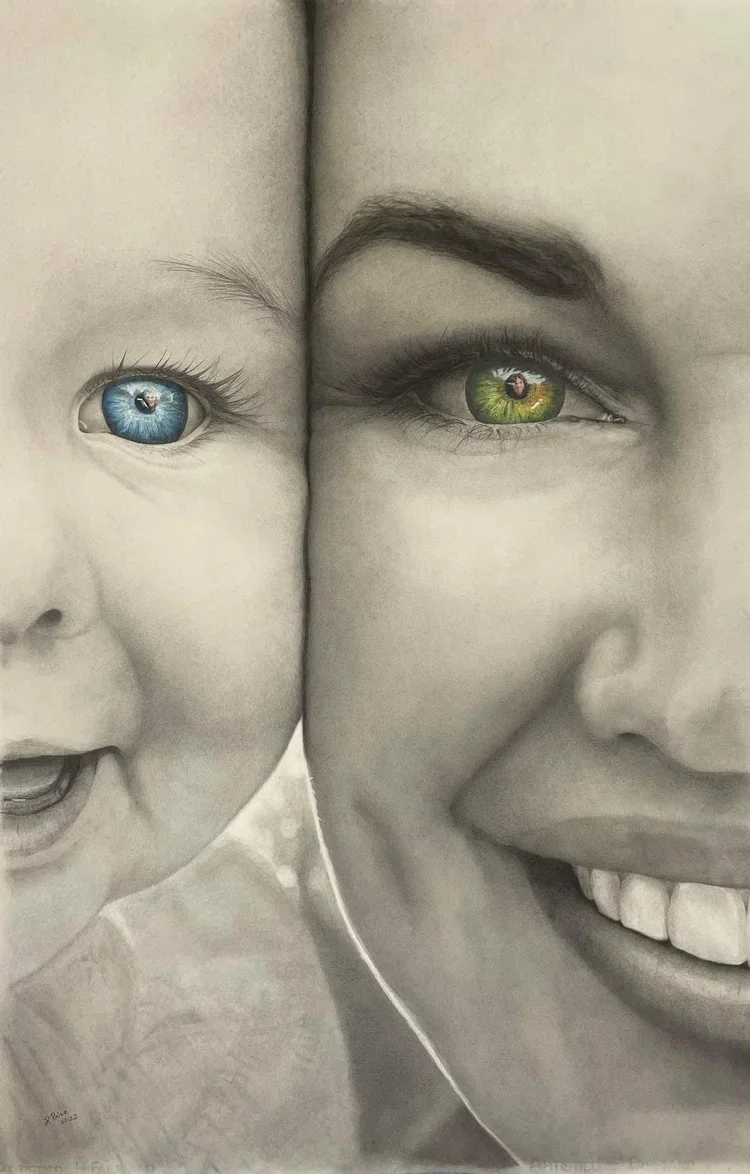
Through the Academy’s program, I began with the Charles Bargue Drawing Course and progressed to charcoal cast studies. It’s all about meticulous observation, understanding how light and shadow turn form, and learning the patience and precision it takes to truly see. That training allowed me to fully embrace these two charcoal commissions—Butterfly Kisses and The Green and the Blue.
As I drew my niece’s twins, the song Butterfly Kisses by Bob Carlisle kept running through my mind. It not only inspired the title but also the delicate watercolour butterflies I included—symbolic of two young people who will one day spread their wings and take flight on their own life journeys.
The Green and the Blue is a family portrait of a mother and child, commissioned by the grandmother. As a surprise for her, I included the grandparents reflected in the eyes—turning it into a true generational portrait.
I love creating work like this—capturing a moment in time, a loved one, something deeply personal. For me, it’s not just about painting a likeness—it’s about connection, emotion, and storytelling.
If you’ve been thinking about a portrait, I’d love to talk.
Warmly,
Rowena
Where My Landscape Inspiration Comes From
Newsletter 19/5/25

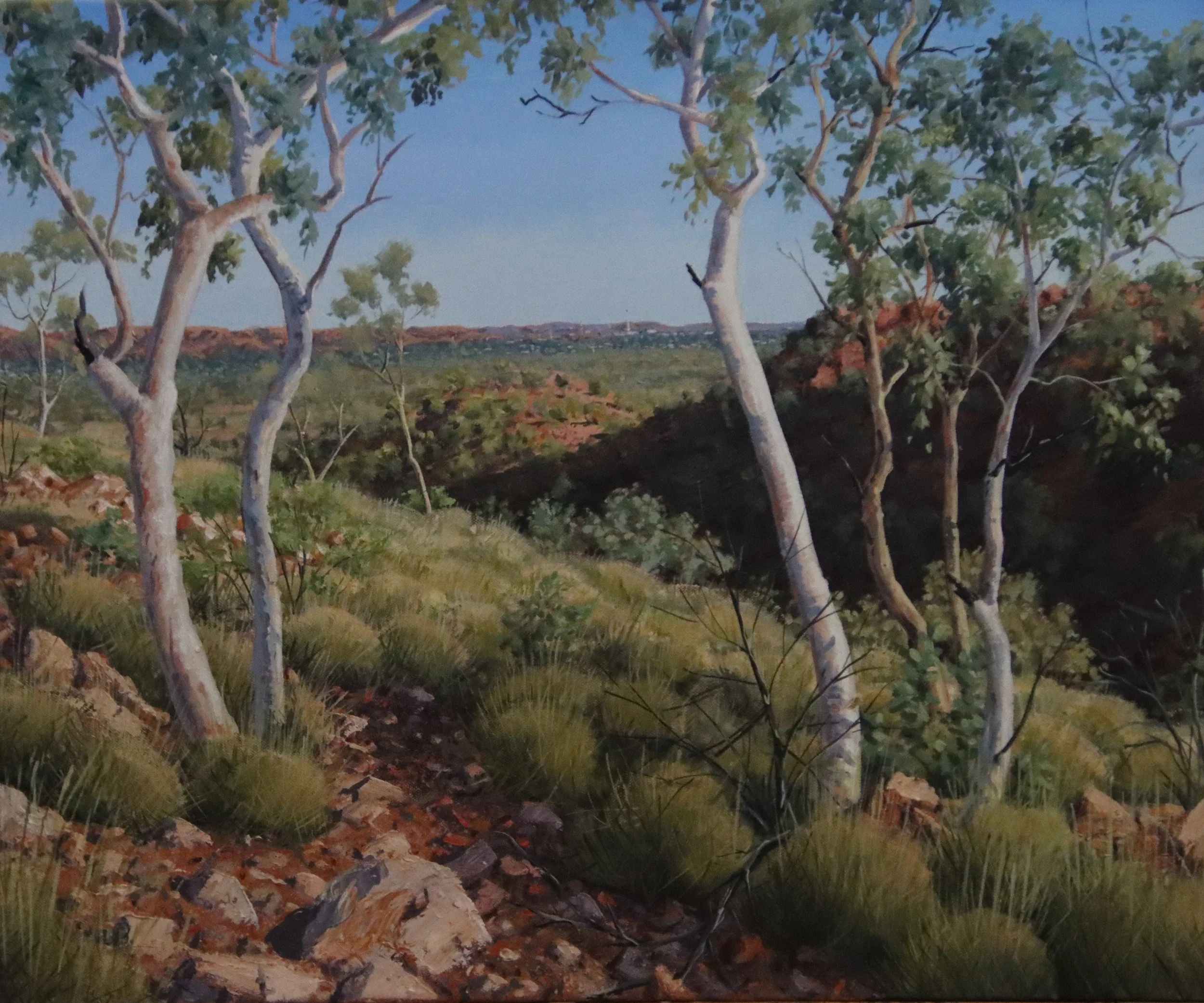
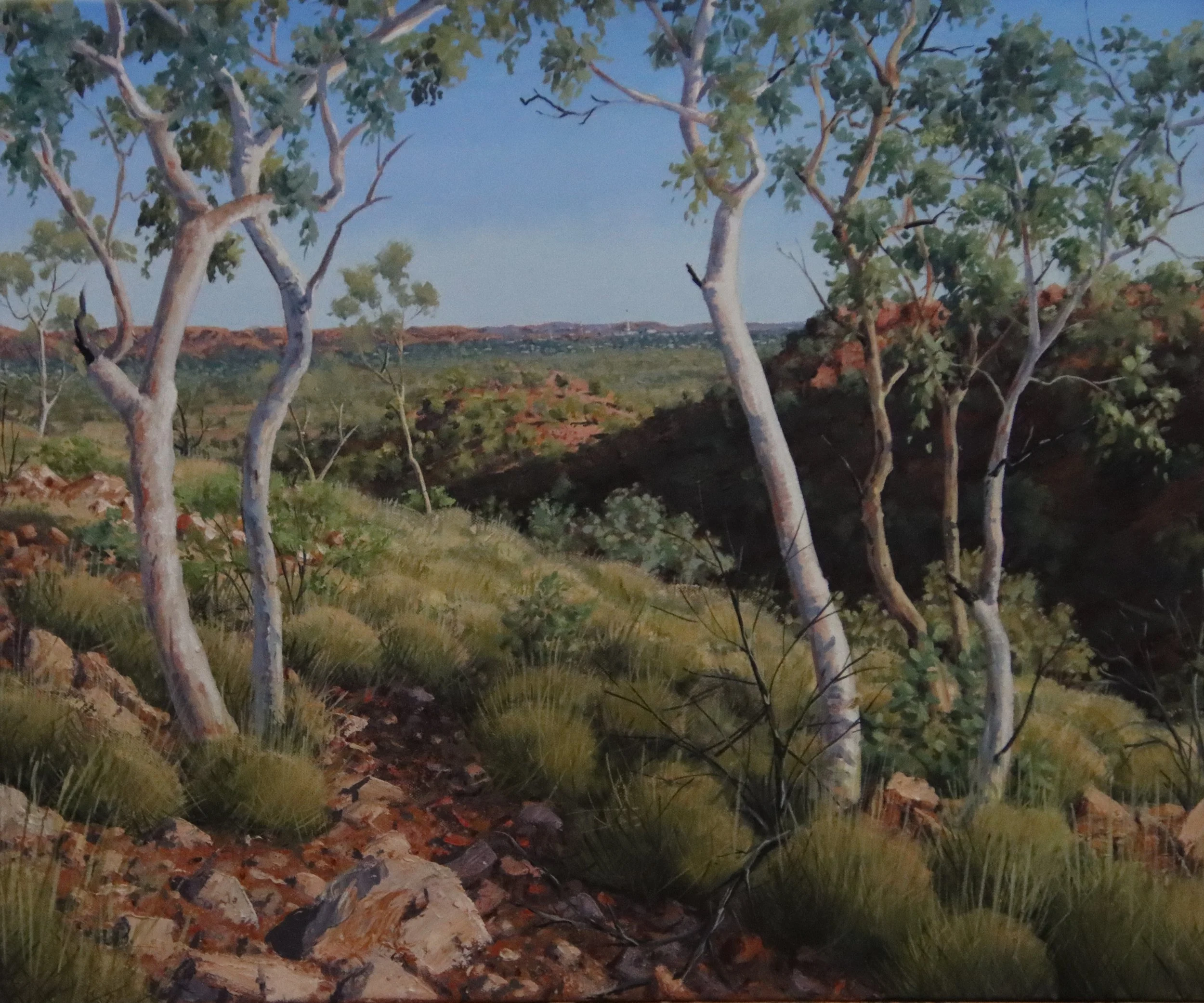
I’m often asked where I get the inspiration for my landscape paintings. The truth is, unless I’m working on a commission and the client has supplied a reference photo, every one of my paintings begins with something I’ve seen myself.
I’d love to do more plein air painting, but in Mount Isa, there are only a couple of weeks each year when the weather is cool enough to make it possible. So, I take a lot of photos. Since I’m usually up at 3am each morning to paint, working from my own photo references is essential. But even though I’m indoors, I can still feel the essence of the bush—the early morning birdsong, the thump of a wallaroo bounding out of sight, startled by this crazy old lady disturbing its peaceful hilltop vista.
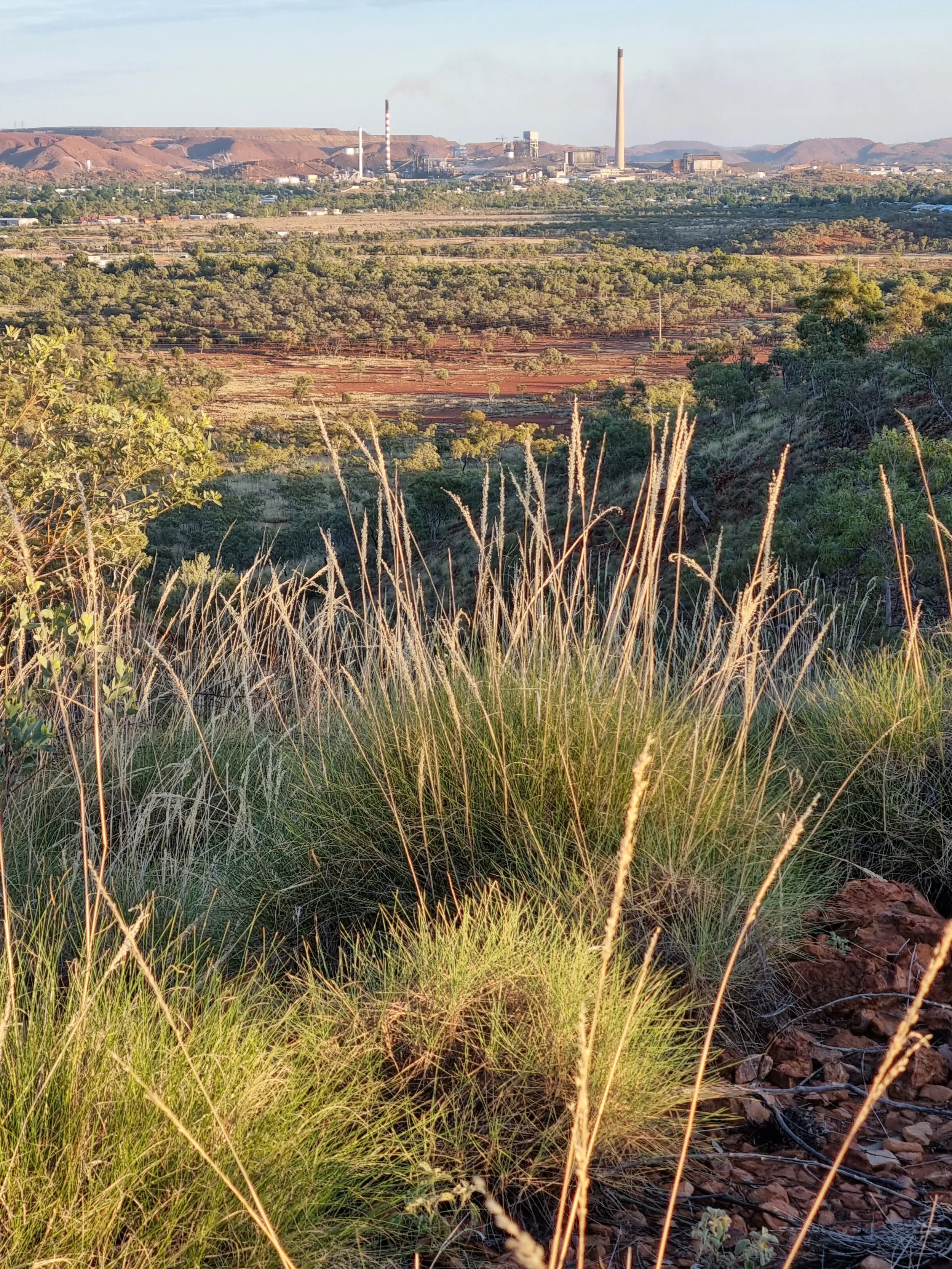
Just this past Sunday morning, my neighbour, my sons, and I climbed the hills in front of where I live. We left in the dark to be on the ridges as the sun rose. Watching the first light slowly illuminate the Mount Isa stacks and the hills behind town is a sight I never tire of. That’s why many of my Mount Isa landscapes feature those iconic stacks in the distance.
There are no walking tracks over these hills, and I’m one of only a handful of people who’ve climbed them. They don’t look too tall from afar, but once you’re up there, navigating the steep terrain—especially coming back down—can be tricky. Thankfully, my trusty walking poles give me spider-like stability on those sharp descents.
I’ve been clambering through this hill range for over 15 years, and each time I end up on a different wallaroo pad, discovering a new area, a different gully, a fresh vista. The landscape is always changing—some years it's dry and bare after fire season, other years it bursts with plant life and blooms you won’t find on the flats.
Yes, I’m sore today. But that high you get from standing on top of the hills, immersed in a world usually seen only by roos and birds, brings peace and balance to my soul. I come home with hands itching to paint what I’ve just experienced—to give others, especially those who can’t make the climb, a glimpse into this wild, beautiful world just beyond the ridgeline.
Have a great week.
Cheers Rowena
Ps Thanks for the photo Marta
“Through the Curry Hills” Newsletter 8/4/25

My latest painting “Through the Curry Hills” for our Cloncurry Exhibition Opening Night 30th of July showing through to the end of August.
I don’t paint pretty postcard pictures, I paint reality. It’s a portrait of resilience, a landscape shaped by time, seared by heat, and carved by flood. This is real Australia—untouched by man, raw and alive.
If you’ve ever stood in the Selwyn Ranges, you’ve felt it— the weight, the remoteness, the immense calm and harsh beauty. Depicting the ancient history of this breathtaking land. The bloodwoods and spinifex are survivors, every bit as tough as the rocky ridges they cling to and the wildlife they shelter.
I didn’t paint this to simply show what I saw. I painted it to share what I feel.
In 2021 my friend, Liz Debney, myself and a dedicated support crew, led over twenty people on foot and on horse from Cloncurry to Mount Isa in an 8-day hike over the Selwyn and Argyle Ranges, to raise money for cuddle beds for Palliative Care.
The cause was a great one, the scenery was spectacular, and the friendships formed, heartwarming. We raised enough money to place one Cuddle Bed in the Cloncurry Hospital and two in the Mount Isa Palliative Care Unit, which was a great effort from everyone.
Click on the link Below, if that doesn’t work, in You Tube, go to Claire Murphy Metalwork then Walk Ride Run for Palliative Care.