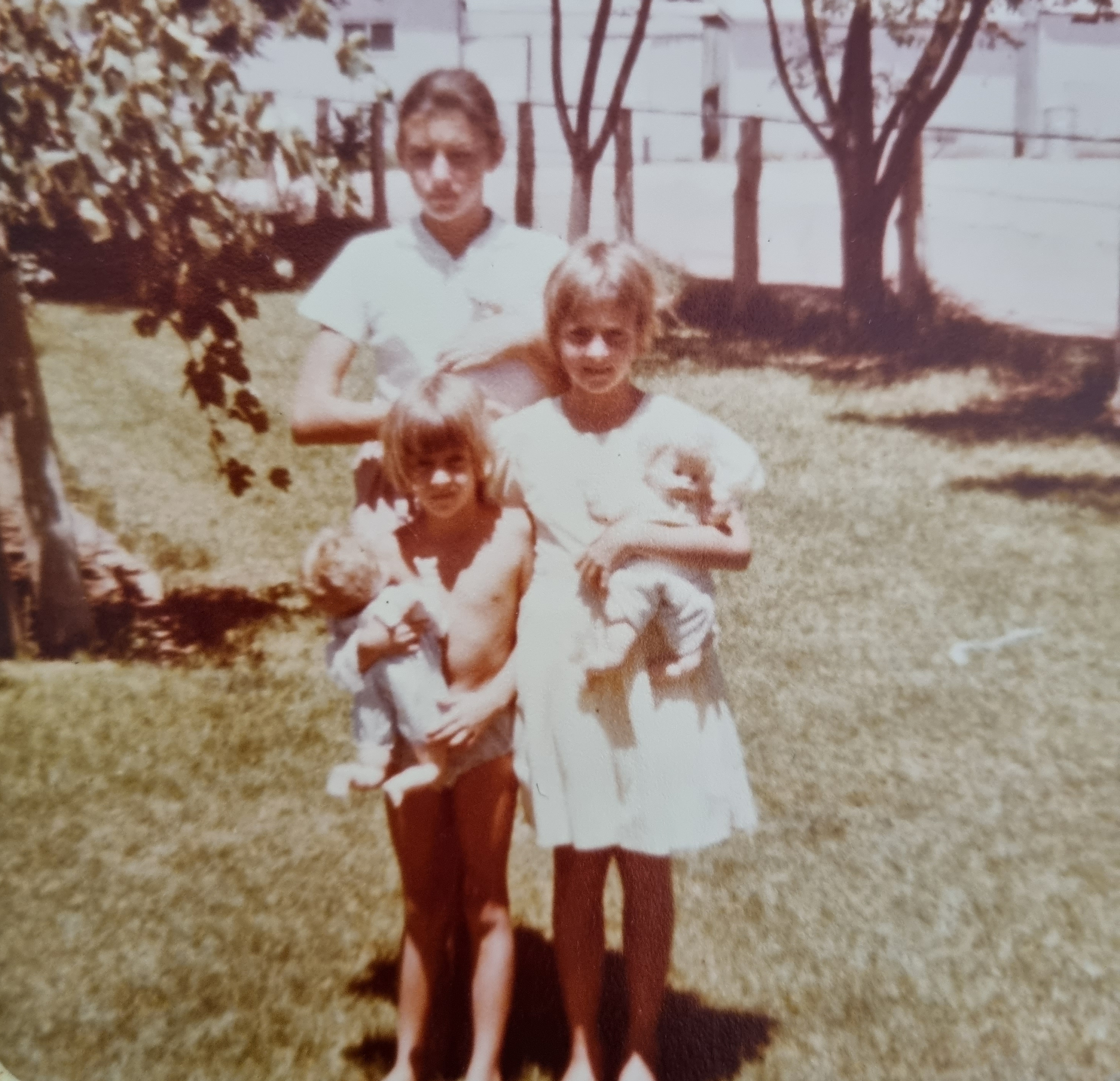
Alcoota Childhood
The other day, while cleaning my office, I found some stories I wrote years ago about my childhood growing up on Alcoota Station. I thought by sharing these, you’ll better understand my love and connection to the land—and how deeply it influences my art. This is part one.
Alcoota is a small cattle station on the Plenty Highway, northeast of Alice Springs in the Northern Territory. My dad managed it for a gentleman in Adelaide. Compared to the larger stations he had managed—Barkly Downs, Lake Nash, and the remote Elsley Station—Alcoota was, as Dad always said, “a holiday.”
For us three youngest of six kids, it was a paradise. Our older siblings were away at boarding school in Charters Towers and only came home for Christmas. We “little girls” were taught through School of the Air and correspondence lessons by an array of governesses—some good, some not so good. (For my American readers: governesses were young women who basically home-schooled children on remote stations.)
Alcoota was run by Dad with occasional help from a mechanic and his family, but mostly it was just us and the community of local Aboriginal people, who worked as stockmen, gardeners, and cleaners. My mum had to be a jack-of-all-trades: cook, gardener, storeman, bookkeeper, secretary for race clubs, sometimes teacher, and often arbitrator for a camp of more than a hundred Aboriginals. She even ran a clinic—handing out cough mixture, sewing up split scalps after fights, and delivering babies. She wasn’t a trained nurse, just a woman who had to cope with all emergencies in the remote outback. Dad was always quick to volunteer her services: “Yes, Ed can do that standing on her head!”—and suddenly Mum had another unpaid job.
Of course, she had three “offsiders.” I remember cleaning halls, scrubbing toilets, and making decorations for the Harts Range Races at a very young age. Looking back, I can see where I inherited my coping strategies and my lifelong habit of volunteering.
As children, though, we had no real sense of our parents’ workload. After breakfast, we’d disappear—on horseback, exploring the creek, or hunting with the Aboriginal ladies. School was a torturous couple of hours shut inside a room. I’d sit gazing out the window, watching the horses coming in to water, working out how far away they’d be when it was time to catch them after school.
Often we’d pack a lunch and just ride all day—playing cowboys and Indians, practicing our mustering skills (unbeknownst to Dad, or so we thought)—and come home at dark. It was a carefree existence: no peer pressure, no drama, just freedom.
And it’s from this childhood—this life on the land—that my art draws its strength and meaning.
“The three little girls” Yes I was one of those children that only wore underpants, even riding our ponys, No safety gear in thoes days!