
Portraits and Landscapes Created with Precision and Care
Welcome to the studio. In this edition, I would like to share more deeply the philosophy and process behind my realistic art, and how both portraiture and Australian landscape painting are approached with patience, discipline, and care.
Every artwork begins with observation. Whether I am studying the subtle structure of a face or the expansive horizon of the Northern Territory, the foundation of my practice is careful attention to light, form, and atmosphere. Realism is not simply about accuracy; it is about conveying presence. It is about ensuring that each fine art drawing or painting feels grounded, authentic, and emotionally resonant.
The Essence of Realistic Portraiture
Creating a compelling portrait drawing requires more than replicating a likeness. It demands sensitivity to character, expression, and nuance. In my realistic portraits, I focus on tonal relationships, anatomical accuracy, and the interplay of light and shadow to capture depth and individuality.
Each subject brings a unique energy to the studio. I spend time understanding the structure of the face, the direction of natural light, and the emotional qualities that define a person’s presence. Through layered graphite or charcoal, I gradually build form. Subtle tonal shifts define cheekbones, eyes, and expression lines. The goal is always to create a work that feels alive — a fine art portrait that reflects both outer appearance and inner spirit.
Patience is essential in this process. Realism cannot be rushed. Every detail is considered, every edge softened or sharpened with intention. This careful method allows the finished work to maintain clarity while retaining warmth and humanity.
Drawing With Graphite and Charcoal
My graphite drawings and charcoal drawings form a significant part of my studio practice. These mediums allow for refined control over tonal values and texture, making them ideal for both portrait and landscape work.
Graphite offers precision. It enables delicate gradations that are vital when rendering skin tones or subtle atmospheric shifts in distant landscapes. Charcoal, on the other hand, provides rich contrast and expressive depth. Together, they allow me to balance control with softness, creating realistic drawings that possess dimension and clarity.
The discipline involved in working with monochrome materials enhances observational skills. Without colour, the focus shifts entirely to light, structure, and proportion. This strengthens the foundation of all my fine art realism, whether the final work remains in black and white or evolves into a painted composition.
Australian Landscape as Inspiration
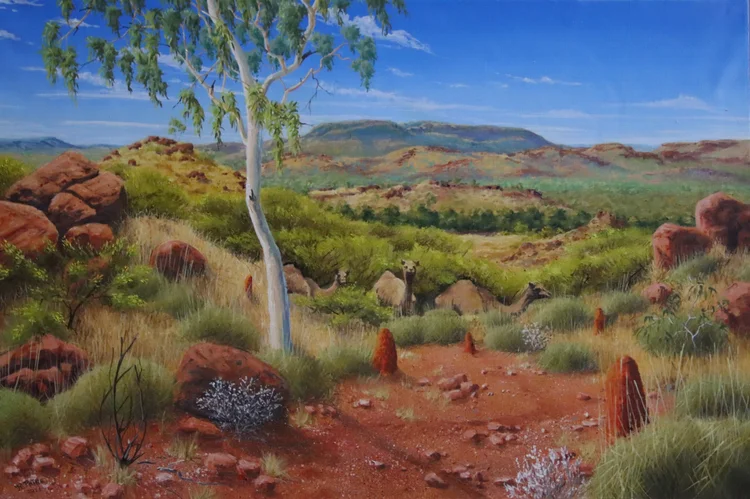
The Australian environment continues to shape my creative direction. Time spent in remote regions, particularly the Northern Territory and Central Australia, has deeply influenced my landscape art.
The vast horizons, red earth, and expansive skies offer a profound sense of stillness and scale. When painting or drawing these environments, I aim to capture not only the physical characteristics of the land but also its atmosphere. The subtle shift of light across rock formations, the quiet intensity of open plains, and the depth of distant ridgelines all contribute to the emotional language of the work.
In my Australian landscape paintings, colour is layered gradually to achieve depth and luminosity. Earth tones are carefully balanced with cooler shadows and expansive skies. Each composition is structured to guide the viewer’s eye across the terrain, inviting reflection and connection.
The land is never treated as a backdrop; it is the subject. Through attentive observation and respect for detail, the finished artwork reflects both memory and lived experience.
The Studio Process
Behind every completed artwork is a structured and thoughtful process. Whether developing a portrait commission or a large-scale landscape painting, the steps remain grounded in preparation and refinement.
Observation and Study
I begin with preliminary sketches and visual notes. These early drawings help determine composition, proportion, and tonal direction.
Reference and Reflection
Photographic references may supplement on-site studies, particularly for landscapes. However, lived experience remains central. The memory of light and atmosphere informs the final composition.
Layering and Development
Realistic art is built in layers. In drawing, tonal values are gradually deepened to create a three-dimensional form. In painting, colour is developed slowly to maintain harmony and balance.
Evaluation and Refinement
Stepping back from work is a crucial stage. This allows for objective assessment of structure, detail, and cohesion. Adjustments are made carefully to preserve integrity and realism.
This measured approach ensures that each original artwork reflects both technical discipline and emotional depth.
Original Fine Art and Collecting
For collectors seeking original Australian art, realism offers enduring appeal. The precision and craftsmanship involved in each piece make it a meaningful addition to both contemporary and traditional interiors.
Owning an original painting or fine art drawing is an investment in authenticity. Unlike mass-produced prints, original works carry the marks of process — subtle variations, layered textures, and the artist’s hand visible in every stroke.
Collectors often respond to the emotional resonance of a piece. A landscape may evoke memories of travel or connection to the country. A portrait may commemorate a loved one or celebrate a personal milestone. These works become part of a space’s identity, enriching the environment with quiet strength.
Commissioning a Personal Artwork
A commissioned portrait or bespoke landscape is a collaborative journey. Clients are invited to share their vision, whether it is capturing a family member, honouring a significant location, or creating a meaningful gift.
The commission process begins with consultation, where we discuss scale, medium, and intention. From there, I develop studies and compositional concepts before progressing to the final artwork. Throughout, communication remains open to ensure the piece reflects the client’s expectations while maintaining artistic integrity.
Commissioned works carry a unique significance. They are created with purpose and care, tailored to commemorate people or places that matter deeply.
Art Rooted in Precision and Care
Precision in art is not about rigidity; it is about respect. Respect for the subject, for the landscape, and for the process itself. Care is present in every decision — from the initial sketch to the final highlight.
In both realistic portraiture and Australian landscape art, my aim is to create work that invites viewers to pause. In a world that moves quickly, detailed realism encourages stillness. It rewards close viewing. It reminds us of the intricacy of the human face and the vast beauty of the land.
Thank you for taking the time to engage with this studio update. Your continued interest in fine art realism, portrait drawing, and landscape painting supports the ongoing exploration of craft and creativity.
As new works continue to emerge from the studio, I look forward to sharing them with you — each one created with dedication, precision, and care.
Warm regards,
Rowena Paine-Murphy